

If you commute by bike across Center City, you know Spruce and Pine. Spruce runs one-way eastbound. Pine runs one-way westbound. They sit one and two blocks south of Rittenhouse Square, and they carry the bulk of the city’s cycling commute volume. The bike lanes are painted, with flex-post separators in some stretches. 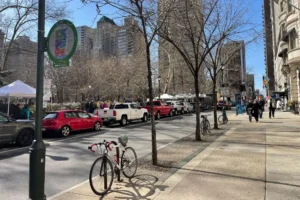
They get blocked anyway. Drivers stop in the lane to drop off rideshare passengers. Delivery vans park there to unload. When that happens, the cyclist behind has no protected line through the block, and that is where the crashes happen, week after week, in patterns that do not depend on a turning conflict or a missed signal. They depend on the simple fact that a vehicle stopped where the bike lane should be open.
If a rideshare drop-off, a parked delivery vehicle, or a driver who drifted into the painted lane left you injured, Rand Spear – The Accident Lawyer can walk you through what your claim looks like under Pennsylvania law. Our practice handles a steady flow of bike-vehicle conflicts.
Why a Painted Bike Lane Does Not Hold Drivers Out
Walnut, Spruce, Pine, 18th, 19th, and 20th are all one-way single-lane streets with continuous parallel parking and a separated bike facility on Spruce and Pine. There is no legal pull-over space at most hotel and restaurant frontages along the corridor.
An Uber or Lyft driver who needs to drop a passenger off on Spruce has two options: stop in the live travel lane and block traffic, or stop in the painted bike lane and block cyclists. Most pick the bike lane.
According to the Spruce and Pine Streets bike-lane safety upgrades project, the City’s Office of Transportation and Infrastructure Systems is hardening this corridor to concrete-separated barriers because of exactly that pattern. The painted line does not carry enough authority to keep drivers out, and the hardening is the City’s response to a problem that has been recurring for years.
The Three-Way Conflict When a Rideshare Stops in a Bike Lane
When a driver pulls into the painted lane to drop off a passenger near 19th and Spruce or 20th and Pine, three things happen at once. The cyclist behind has no protected line through.
They either swing left into the live travel lane, where a vehicle is now coming up at speed, or they stop short and hope the driver behind them is paying attention. The passenger in the back seat opens the curbside door into the bike lane without checking for a rider. And the driver behind the parked rideshare reads the stop too late.
Door-zone strikes and rear-end conflicts in the bike lane are the two most common crash patterns along this corridor. Mature street trees along Spruce, Pine, Locust, and Delancey create deep canopy shadows at night. In addition, historic-district lampposts provide lower lumen output than modern LED lighting. As a result, block faces between 18th and 22nd Streets are noticeably darker than the Walnut commercial spine. This reduced visibility is most pronounced after 10:00 p.m., when rideshare demand increases from restaurants around Rittenhouse Square and from South Street nightlife.
Why the Friedes Case Drove the City’s Concrete-Barrier Push
The Friedes case, A 2024 fatal cyclist crash on Spruce Street in the Rittenhouse stretch, became a key catalyst for the City’s concrete-barrier redesign. The crash itself was not a typical pickup-zone or curbside loading conflict. It involved an impaired driver entering and traveling within the bike lane at speed.
While that specific event was unusual in its cause, the resulting redesign addresses a broader set of recurring risks. These include both unintentional driver drift into the bike lane and intentional encroachment when drivers stop or park in the lane to load passengers. Together, those patterns illustrate why a painted line alone is insufficient on a corridor with sustained cycling volume and heavy rideshare activity.
According to Vision Zero Philadelphia, in 2024, less than 10 percent of city crashes involved people walking, biking, rolling, or riding a motorcycle. Those vulnerable road users accounted for nearly two-thirds of fatalities. The math lands on cyclists especially hard on Spruce and Pine.

Frequently Asked Questions About Rittenhouse Square, Philly Bike-Lane Crashes
-
Who Is Liable if a Rideshare Driver Doors Me on Spruce or Pine Around Rittenhouse Square?
Liability typically runs against the at-fault party, usually the passenger who opened the door without checking, the driver who parked in the bike lane, or both.
-
Where Do Most Bike-Lane Crashes Happen in Rittenhouse Square, Philly?
The highest concentrations are along Spruce Street eastbound and Pine Street westbound between 17th and 22nd, where rideshare drop-off and delivery vehicle parking chronically block the painted lanes. The corridor’s stretch on the south side of the square sees the highest cyclist commute volume in Center City, which is why the City prioritized concrete-barrier upgrades there.
-
How Long Do I Have to File a Pennsylvania Claim After a Bike-Lane Crash in Rittenhouse Square, Philly?
Pennsylvania’s general personal injury statute of limitations is two years from the date of the crash. Bike-lane crashes around Rittenhouse Square involve private companies and private drivers, so the state-agency 6-month notice rule does not apply. Insurance coverage and evidence, such as app data, dashcam footage, and witness contact details, are most reliably preserved when a lawyer is involved early.
Talk to a Rittenhouse Square, Philadelphia Bike Accident Lawyer at Rand Spear – The Accident Lawyer
If a rideshare drop-off, parked delivery vehicle, or driver crossing into a painted lane left you hurt on Spruce or Pine or around Rittenhouse Square, Rand Spear – The Accident Lawyer can review the facts, pull the app and coverage data, and explain what a claim looks like under Pennsylvania law. Call a Rittenhouse Square, Philadelphia bike accident lawyer at 215-985-0138 or contact us online to schedule a free consultation. With offices in Philadelphia, Cherry Hill, and Marlton, NJ, we serve injured clients throughout Pennsylvania and New Jersey.
Call or text (215) 985-2424 or complete a Free Case Evaluation form